
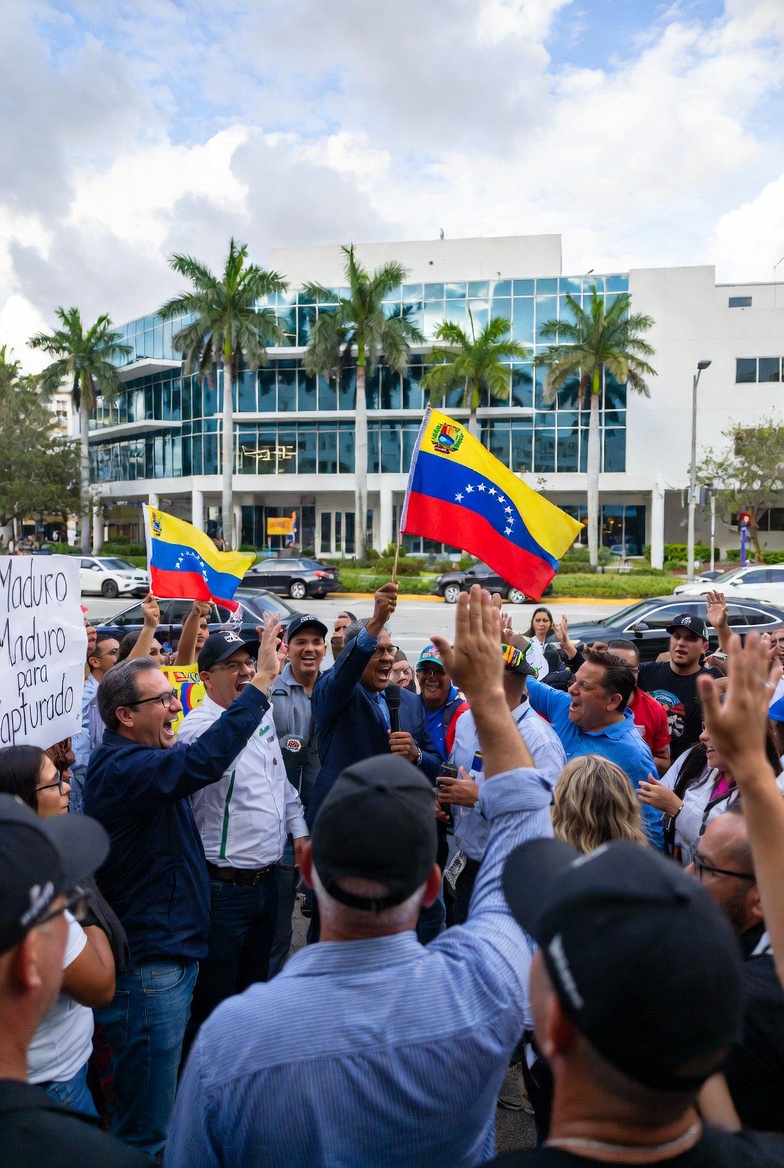
Miami, Florida — Venezuelan expatriates and members of the Venezuelan diaspora across South Florida have spent more than 12 hours celebrating in the streets of Miami-Dade County following reports that longtime Venezuelan leader Nicolás Maduro has been captured. The scenes of jubilation, centered primarily in Doral, Weston, and other Venezuelan-American hubs, reflect years of pent-up emotion among a community shaped by exile, political repression, and economic collapse.
Crowds waving Venezuelan flags, chanting calls for freedom, and embracing strangers filled major intersections late into the night and into the following day. For many participants, the moment represented something they had waited for over a decade to witness.
While celebrations unfolded thousands of miles from Caracas, the reactions in Miami quickly became one of the most visible public responses anywhere in the world.
A Night That Turned Into a Day of Celebration
What began as spontaneous gatherings quickly grew into sustained demonstrations of joy and relief. According to local reporting and eyewitness accounts, Venezuelans began assembling shortly after news of Maduro’s capture spread through television broadcasts, WhatsApp groups, and social media platforms.
By midnight, crowds had swelled. By morning, they were still there.
Families arrived with children wrapped in yellow, blue, and red flags. Cars drove by honking horns in support. Music played. Some participants cried openly, while others prayed or sang the national anthem.
For many, this was not a protest — it was a release.
Why Miami Became the Center of Celebration
South Florida is home to one of the largest Venezuelan communities outside Venezuela, with tens of thousands of residents who fled political persecution, economic collapse, or lack of opportunity under Maduro’s government.
Doral: “Doralzuela”
The city of Doral, often referred to as “Doralzuela,” became the epicenter of the celebrations. Restaurants, gas stations, and public sidewalks transformed into gathering points as people shared food, stories, and memories of the country they left behind.
Many said they had lost contact with relatives, careers, or entire futures after leaving Venezuela. For them, the capture of Maduro symbolized the possibility — however uncertain — of change.
Who Is Nicolás Maduro?
Nicolás Maduro has governed Venezuela since 2013, succeeding Hugo Chávez. His presidency has been defined by:
- Economic collapse and hyperinflation
- Severe shortages of food and medicine
- Mass migration of over seven million Venezuelans
- Accusations of election manipulation
- Allegations of human rights abuses
- U.S. indictments related to drug trafficking
The United States and several allied nations have long refused to recognize Maduro as the legitimate president, instead imposing sanctions and pursuing legal action against members of his government.
For many Venezuelans in exile, Maduro’s name became synonymous with loss.
“This Is the First Time I’ve Felt Hope”
Among the crowds in Miami, a recurring sentiment emerged: hope — cautious, emotional, and deeply personal.
“I left Venezuela with nothing,” said one attendee. “Tonight is the first time I feel like maybe it wasn’t forever.”
Others described the moment as historic, even if they acknowledged that Venezuela’s future remains uncertain.
Many participants stressed that the celebration was not about foreign intervention, but about accountability.
Not Celebrations in Venezuela — But in Exile
It is important to distinguish where these celebrations are happening.
There is no verified evidence of mass, sustained celebrations inside Venezuela itself. Inside the country, reporting suggests fear, uncertainty, and limited public expression due to political repression and security concerns.
In contrast, exile communities — particularly in Miami — are able to express emotions freely.
This distinction is critical for accurate reporting and responsible journalism.
How Long Have Celebrations Lasted?
Local media outlets and live footage show that celebrations extended for more than 12 consecutive hours, with people arriving and leaving while others stayed through the night.
The continuous presence of crowds — rather than one brief rally — is what makes the Miami reaction notable.
The Role of Social Media in Amplifying the Moment
Platforms such as X, Facebook, Instagram, and TikTok played a central role in spreading both the news and images of celebration.
Videos of Venezuelans hugging, singing, and chanting quickly went viral, drawing international attention and reinforcing Miami’s role as a political and emotional center for the diaspora.
Journalists caution, however, that some viral clips circulating online have been misattributed or taken from older events — highlighting the need for verification.
Political Reactions in the United States
U.S. political figures responded cautiously but acknowledged the emotional impact on Venezuelan communities.
Some lawmakers described the celebrations as evidence of how deeply Maduro’s rule affected Venezuelans abroad. Others urged restraint and emphasized that Venezuela’s future should ultimately be determined by its people.
No official U.S. statement characterized the celebrations as policy endorsement.
Why the Venezuelan Diaspora Reacts So Strongly
Unlike many immigrant communities, Venezuelan exiles are often recently displaced, politically active, and deeply connected to events back home.
Many still have:
- Parents living in Venezuela
- Property they cannot access
- Bank accounts frozen or lost
- Professional credentials rendered useless
For them, Maduro’s capture represents not just a political development, but a personal reckoning.
What Comes Next for Venezuela?
Despite the celebrations, experts warn that Maduro’s capture does not equal immediate stability.
Venezuela faces:
- Institutional collapse
- A fractured opposition
- Economic devastation
- Massive humanitarian needs
Even optimistic analysts caution that rebuilding could take years.
The Miami celebrations reflect hope — not certainty.
The Emotional Weight of Exile
Psychologists studying exile communities note that moments like this can trigger collective emotional release.
Years of grief, anger, and nostalgia often surface simultaneously.
That may explain why celebrations continued long after midnight — and why strangers hugged like family.
Miami’s History With Political Exiles
Miami has long been a focal point for political exile communities, including Cubans, Nicaraguans, Haitians, and Venezuelans.
Public celebrations following political developments abroad are not new — but the scale and duration of the Venezuelan response stands out.
Media Responsibility in Breaking News Moments
As images spread rapidly, journalists and publishers face heightened responsibility to:
- Verify location and timing
- Avoid exaggerated claims
- Distinguish diaspora reactions from domestic ones
Accurate framing is essential for credibility, especially on platforms like Google News.
What the Celebrations Do — and Don’t — Mean
What They Mean:
- Venezuelan exiles feel heard
- The moment carries symbolic weight
- The diaspora remains politically engaged
What They Don’t Mean:
- Immediate change inside Venezuela
- Universal agreement among Venezuelans
- Resolution of Venezuela’s crisis
Voices of Caution Among the Crowd
Not everyone celebrating expressed unqualified optimism.
Some attendees urged patience, warning against unrealistic expectations.
“We celebrate today,” one man said, “but tomorrow the work begins.”
The Global Venezuelan Diaspora Watches Closely
Beyond Miami, Venezuelan communities in Spain, Colombia, and other U.S. cities also reacted — though none matched the scale seen in South Florida.
Miami’s role as a media hub amplified its visibility.
Final Analysis: A Moment of Release, Not Resolution
The 12-hour celebrations in Miami are less about victory and more about emotional release.
They represent grief, resilience, memory, and hope converging in one place.
For a community shaped by loss, the moment mattered — regardless of what happens next.
Conclusion
As Venezuelans in Miami celebrated through the night and into the day, their message was clear: exile does not erase connection, and time does not erase pain.
Whether this moment marks the beginning of real change or simply a symbolic chapter, it has already entered the historical record as a powerful expression of diaspora identity.
The world will now watch what follows — both in Venezuela and far beyond its borders.